
Haggett Hall: A Study on the benefits of System Framing in multi-family construction
On large-scale multi-family projects, the building structure is no longer evaluated solely by spans and loads. It’s evaluated on whether it can accommodate the growing complexities of modern building systems: bigger ductwork driven by new energy codes, more dense plumbing and fire protection systems, and tighter floor-to-floor height targets — all while providing safer work conditions for all trades.
That was exactly the situation at Haggett Hall, a 230,000 square foot student housing project, on the University of Washington's campus in Seattle.
The project team faced a familiar challenge: maximize usable square footage, preserve ceiling height, and keep the trades working together without turning coordination into a schedule killer.
Under a conventional framing approach (16-inch on-center platform framing using wood I-joists and structural rim board), the corridor areas and units would have been full of conflicts and obstacles. Think: tight spaces, dropped soffits, and countless floor system penetrations to accommodate mechanical, electrical, and plumbing systems.
Instead, Haggett Hall became a proving ground for what is now called the “Trim-Ply System”, a concept developed by Engineered Wood Solutions, which aligns three complementary solutions: TrimJoist floor joists + Freres Mass Ply Panels + Tall Wall Framing Approach.
On Haggett Hall, TrimJoist open-web, trimmable floor joists (11 7/8” depth) were installed at 24 inches on-center. Tall Wall framing was used throughout (a semi-balloon approach renamed for clarity and repeatability), and Freres 4” Mass Ply Panels were installed in all of the corridor areas. The three elements were used together as an integrated system designed to: make floor system installation easy, safe, and straightforward, create open pathways for mechanical and plumbing systems, and shorten the overall construction schedule.
The result? The new Trim-Ply System not only delivered, but exceeded expectations in all three areas.
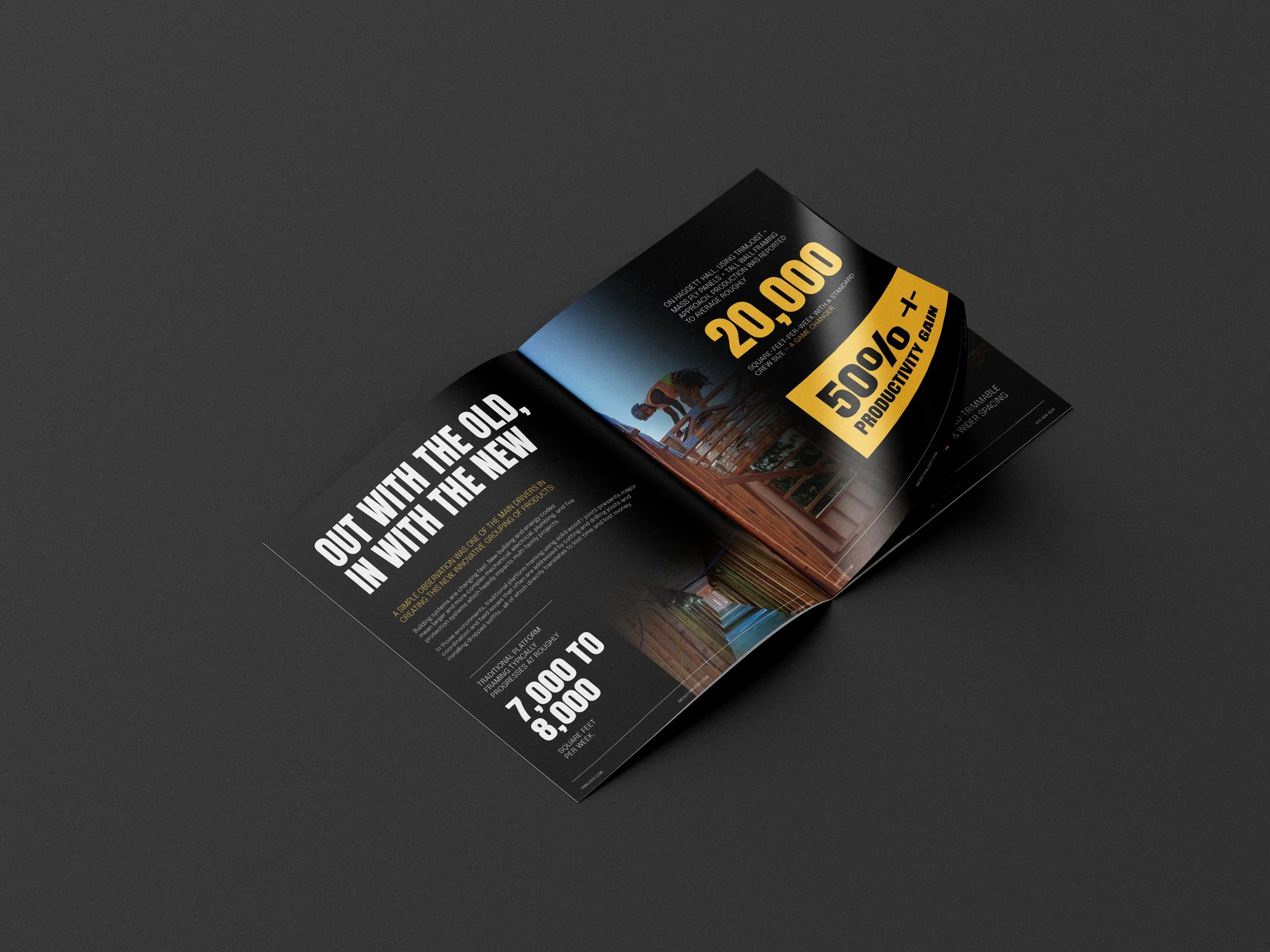
Out with the Old, In with the New
A simple observation was one of the main drivers in creating this new, innovative grouping of products: building systems are changing fast. New building and energy codes means larger and more complex mechanical, electrical, plumbing, and fire protection systems which heavily impacts multi-family projects.
In those environments, traditional platform framing using solid wood I-joists presents major coordination and field issues that often are addressed by cutting and drilling joists and installing dropped soffits… all of which directly translates to lost time and lost money.
The Haggett Hall schedule initially projected 8,500 to 9,000 square feet of framing installation per week. By using TrimJoist + Freres Mass Ply + the tall wall framing approach, square-feet-per-week with a standard crew size — a game changer.
The TrimJoist System Meant Simplified Coordination and Quick Floor System Install
The chosen joist in the Trim-Ply System was TrimJoist - a field-trimmable, open-web joist designed for longer spans and wider on-center spacing while maintaining a strong floor performance. TrimJoist’s engineered strength paired with it’s trimmability allows the product to perform like a truss and install like a wood I-joist, while it’s rounded web design helps reduce the potential for floor squeaks.
For the MEP trades, the TrimJoist product created simplified model coordination and straightforward field installation from the start. Unlike solid I-joists that require field drilling and modifications or drop-down soffits for MEP routing, the open-web configuration meant trade workers were able to run their coordinated systems quickly and safely through the floor system structure, saving time and money.
Additional advantages of using TrimJoist on Haggett Hall were the product’s quick delivery and on-site field trimmability. “One of the larger benefits of using TrimJoist is they are adaptable to the size you need. In the field, you can cut them to the size needed, whereas a truss that's built off site has to be built to the perfect size of the structure,” said Charlie Schmidt of Superior Structures, the framing contractor on the project.
Another Schedule Accelerator: The Freres Mass Ply Corridor System
Due to trade congestion, sequencing of trade work, and limited floor cavity space, corridors in multi-family buildings often create the greatest number of bottlenecks.
At Haggett Hall, Freres Mass Ply Panels were the primary product used in the corridor areas which proved highly complimentary to the TrimJoist system. Panels were manufactured to corridor widths and could be produced in lengths up to 48 feet. This minimized pieces, cuts, and handling and created a solid working surface with a broad, clear routing channel above. The Mass Ply system impressively supported the density of services that had to move through the building corridors and into the units.
The impact was described in practical jobsite terms: corridor framing that typically took days now took hours. Trades reported that the corridor zone became easier to build, easier to access, and easier to coordinate.
Tall Wall Framing = Less Material, Less Labor
The benefits are even greater when you bring the Tall Wall framing approach into the mix alongside TrimJoist and Mass Ply Panels. In this approach, the wall continues to the underside of the sheathing and the TrimJoist members are hung from the top plate by hangers. “The use of hangers sped up the installation of the TrimJoist system by upwards of 30%,” said Schmidt. This also meant rim board was not needed which directly equated to reduced labor and reduced material cost — again, saving time and money. Load transfer improved, hardware requirements decreased, and typical platform-framing constraints such as rim board thickness, drilling, and attachment complexities were eliminated.
120% Productivity Gain in Faster Floor Framing that Benefited Multiple Trades
While weekly output is influenced by multiple factors, the reported performance aligned with the project’s broader goal: less time lost to field modifications, fewer interruptions from trade conflicts, and fewer schedule delays caused by corridor bottlenecks. Those time savings did not remain isolated within framing alone…they cascaded into other scopes and benefited multiple trades.
Mechanical teams reported less ladder work and fewer situations requiring workers to cut large penetrations through structural members — activities that carry both labor cost and safety risk. “The safety benefits are great because our crew did not have to be on the ladders nearly as long as they would if they were physically drilling. With TrimJoist, they were able to focus on the installation of the product,” Roger Johnson, Senior Project Manager at Auburn Mechanical.
Drywall and insulation scopes also recognized the benefits of this system. With MEP routing handled inside of the floor cavity rather than underneath it, the project reduced the need for soffits… one of the most common pain points in multi-family interiors. Also, by using TrimJoist, the required floor assembly fire rating was achieved with a single layer of drywall rather than the two layers typically required with a traditional I-joist system, reducing material and labor cost.
Cost Competitiveness - System Framing Cost vs. Traditional Framing Cost
Stakeholders were initially concerned that the integrated system was slightly more expensive on a strict material line-item comparison. Yet, when they considered the system as a whole, the broader project economics told a different, more cost-effective story.
The project team indicated the general contractor was positioned to deliver the building to the University of Washington six months ahead of schedule. For an owner, that kind of acceleration is more than schedule performance, it’s revenue performance.
In multi-family housing, having units rented even one month sooner can add up to significant income across a project. It changes the question from “What did the framing scope of work cost?” to “What did the framing scope of work make possible?”.
What is especially notable is how the productivity gains of this system spread from contractors to architects, engineers, and owners. While contractors may have been the initial audience most excited about a system like this, engineers and architects quickly began asking the most urgent questions: how can multi-family buildings be framed to better address fire and acoustic assemblies, reduce or eliminate soffits, maintain floor-to-floor heights, and enhance overall structural performance?
“The combination of TrimJoist, Mass Ply, and Tall Wall construction makes for a very efficient construction project both in terms of material and time, and something we now recommend to all of our clients,” Andrew Stewart, Project Architect at Mahlum Architects.
Even for engineers new to the Trim-Ply System, the results were immediate and measurable. The team now recommends integrating it as early as possible in the planning phase.
“The system is great. It's new. We hadn't worked with it before, and it brought new ideas to the table that really simplified the process,” said Andrew Ayling, Structural Project Manager at Coughlin Porter Lundeen. “It added flexibility and speed to the project.”
A Case Study in Rethinking Floor System Framing
The Haggett Hall experience reflects a broader change in multi-family construction: An industry shifting from single material line-item-by-line-item thinking towards overall system-based thinking. The Trim-Ply System worked because it was treated as a coordinated solution that improved outcomes not just for framing crews, but for many other trades on the project.
The takeaway is that we can — and should — rethink how we frame. When we step back and look at the floor system through a different lens, we can better anticipate and accommodate MEP density, fire and acoustic assemblies, corridor routing, and the sequencing realities of a large-scale projects.
In the context of multi-family construction where speed, repeatability, and coordination are constant constraints, the results at Haggett Hall send a clear signal: the biggest gains won’t come from shaving cents off materials, they’ll come from thinking, planning, and building smarter from the start.
Click here to download the case study
Haggett Hall: A 230,000 SF Student Housing Facility located in Seattle, WA using TrimJoist + Freres Mass Ply + Tall Wall Framing Approach